In development. Paritas is not for sale yet. We are aiming to release it next quarter.pgrecon, our free assessment tool, is available now
Paritas
Moving off Oracle

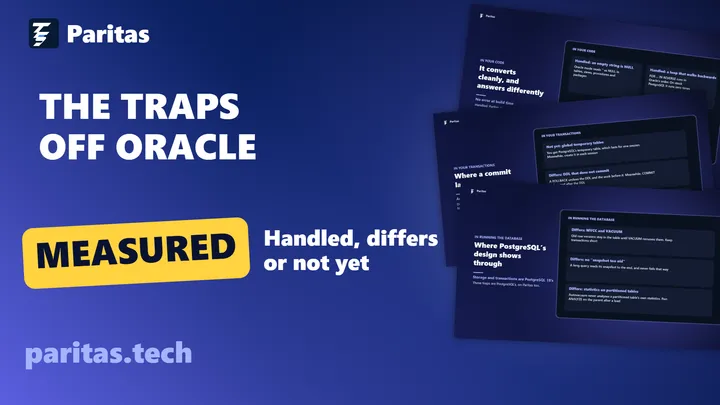
The traps in moving off Oracle, and how we handle each

People who have moved an estate from Oracle to PostgreSQL know the list: the empty string, temporary tables, transaction handling, MVCC and VACUUM, transaction ID wraparound. Here is each one, what Paritas and pgrecon do about it, and where they do not do anything yet.

We say only what our own measurements and documents back. Where they do not cover a trap yet, we say so. Paritas is in development and not for sale yet; we are aiming to release it next quarter.

On film
The traps of moving off Oracle, and what Paritas does about each. In your code, in your transactions and in running the database: the traps Paritas handles, and where it does nothing yet. A film loads from YouTube only when you press play. 1:26
In your code

Code that converts cleanly and still answers differently

An empty string is NULL on Oracle

On Oracle, '' is NULL. On PostgreSQL it is a value, so a test for NULL, a CHECK or a join quietly changes meaning, with no error.

On Paritas
HandledOracle mode reads '' as NULL, in your tables, views, procedures and packages. Two corners differ: DBMS_OUTPUT.PUT_LINE(NULL) reads back as an empty string, and an empty q-quote, q'[]', is a string of length 0, so write NULL or '' instead.
pgrecon
Flags the empty-string NULL trap in your PL/SQL.
Restores
A PostgreSQL archive read by Oracle's rules would turn CHECK (s <> '') into s <> NULL without a word. So Paritas refuses an archive it did not make, before its first object.

The same code, a different answer, and no error

A loop that walks backwards runs zero times on PostgreSQL. UNION and INTERSECT without brackets bring back other rows. Binary floats past the top of their range raise an error instead of giving infinity. None of it fails at build time.

On Paritas
HandledEach of these gives Oracle's answer, measured on Oracle 21c. Across our corpus, 690 of the 829 cases Oracle answers match it (10 November 2026).
Still differs
DiffersInteger division (10/4 is 2), the digits of a quotient, and GREATEST with a NULL. Each has a way round on the compatibility page.
pgrecon
Reads your code, not its answers: it shows which constructs you use, and our test harness measures how they answer.
Do this too
Run your own application's tests against Oracle and Paritas side by side, and compare the answers. That is how we test Paritas itself.

Hierarchical queries

CONNECT BY, START WITH and PRIOR have no direct equivalent in PostgreSQL.

On Paritas
Not yetA syntax error today, and on our work list. Meanwhile, WITH RECURSIVE does the walk, and generate_series replaces the row generator.
pgrecon
Flags CONNECT BY, and its converter declines it by name rather than guessing.

Oracle's (+) outer join

Old code is full of WHERE a.id = b.id(+), which PostgreSQL does not read.

On Paritas
Not yetNot accepted.
pgrecon
Rewrites it as a LEFT JOIN.

ROWNUM and the pagination idiom

Oracle numbers rows at one place in each query block. Pagination written for Oracle depends on exactly where.

On Paritas
HandledSince 7 and 8 November 2026, ROWNUM is counted for each query block as Oracle counts it, in joins, in subqueries and in the nested pagination idiom.
pgrecon
Flags ROWNUM, which matters most for a move to plain PostgreSQL.

The built-in DBMS_ and UTL_ packages

Real PL/SQL calls Oracle's supplied packages constantly, and PostgreSQL has none of them.

On Paritas
DiffersDBMS_OUTPUT, DBMS_LOB, UTL_RAW and part of DBMS_UTILITY are there. In our gauntlet of real schemas, 1,436 of 2,994 package call sites resolve (8 October 2026). DBMS_SQL, UTL_FILE, DBMS_CRYPTO and three more are planned for the first release. The network and XML packages and DBMS_SCHEDULER are left out of it by decision.
pgrecon
Flags calls to UTL_FILE, UTL_HTTP, UTL_SMTP, UTL_TCP, DBMS_SQL, DBMS_LOB and DBMS_OUTPUT, and rewrites the scheduling calls.
In your transactions

Where a commit lands, and what a rollback undoes

Temporary tables

Oracle's global temporary table is a permanent definition whose rows are private to each session. PostgreSQL's temporary table lasts only for the session that made it.

On Paritas
Not yetCREATE GLOBAL TEMPORARY TABLE makes PostgreSQL's temporary table, with a warning, so another session, or the same code after a reconnect, finds no table. The schema-qualified form, as DBMS_METADATA writes it, is refused. Within the session, ON COMMIT DELETE ROWS and PRESERVE ROWS act as Oracle's. Oracle's global temporary tables are on our work list.
Meanwhile
Create the temporary table in each session, before the code that uses it.
pgrecon
Flags global temporary tables in your schema.

DDL commits on Oracle, and not on PostgreSQL

Oracle commits before and after each DDL statement, so a ROLLBACK after a CREATE TABLE or a TRUNCATE undoes nothing. Code written for Oracle relies on that.

On Paritas
DiffersDDL is transactional, as in PostgreSQL: the ROLLBACK undoes the DDL and the work before it, with no error. An implicit commit, as Oracle does it, is on our work list.
Meanwhile
COMMIT before and after the DDL.

A COMMIT inside a procedure

Oracle lets a procedure commit almost anywhere. PostgreSQL does not let a function, or code running with its owner's rights, end a transaction.

On Paritas
DiffersA COMMIT or ROLLBACK is refused in a standalone procedure with the default rights, in a block that has an exception handler, and in a function. Uncaught, the call fails and its work is lost.
Meanwhile
Declare such a procedure AUTHID CURRENT_USER, or make it a package's procedure, and commit outside the blocks that have handlers.

Autonomous transactions

Logging and audit code often commits its own work with PRAGMA AUTONOMOUS_TRANSACTION, whatever the caller does next.

On Paritas
Not yetA procedure holding the pragma is created with a compilation error, and each call fails, so you find out at once. Autonomous transactions are planned for the first release. We will not ship a shim that fakes them: we measured the usual way round, a call back into the same database, and it can wait on its own caller's lock with no deadlock reported.
pgrecon
Flags autonomous transactions, and its converter declines them by name.
In running the database

Where PostgreSQL's design shows through

Paritas's storage, transactions, planner and executor are PostgreSQL 18's. That is why PostgreSQL's tools and extensions work on it, and it means these traps are PostgreSQL's, on Paritas too.

MVCC and VACUUM

Oracle keeps a row's old versions in undo. PostgreSQL keeps them in the table itself, until VACUUM removes them.

On Paritas
DiffersPostgreSQL's design. A long query never fails with "snapshot too old", because it reads its snapshot to the end. But while a transaction stays open after writing a row, or holds a REPEATABLE READ or SERIALIZABLE snapshot, VACUUM cannot remove the versions that ended after it began, and a table updated often grows. Once the transaction ends, VACUUM removes them and the space is reused.
Do this
Keep transactions short. Watch xact_start, backend_xmin and backend_xid in pg_stat_activity, and n_dead_tup in pg_stat_user_tables. Set autovacuum per table for rows updated very often.
Also
Flashback queries are not there, as there is no undo to read. Use point-in-time recovery from the WAL archive, or a history table a trigger fills.

Transaction ID wraparound

PostgreSQL's transaction IDs come from a counter that wraps round, and VACUUM has to freeze old rows before it does. A database that falls too far behind stops taking writes to protect itself.

On Paritas
Not covered yetOur own documents do not cover wraparound yet, and we have measured nothing of our own on it, so we claim nothing beyond PostgreSQL. Paritas's storage and transactions are PostgreSQL 18's, so PostgreSQL's own guidance on routine vacuuming is the place to start.

Statistics and the optimiser

Oracle gathers statistics with DBMS_STATS and takes hints in comments. PostgreSQL does both its own way.

On Paritas
DiffersAutovacuum's analyze keeps a table's statistics, but never a partitioned table's own, so run ANALYZE on the parent after a load. DBMS_STATS is planned; until then, ANALYZE. Optimiser hints are read as comments; pg_hint_plan can be installed beside Paritas.
pgrecon
Flags optimiser hints, plan baselines and global indexes on partitioned tables.

When one server process stops

Paritas runs PostgreSQL's server processes in place of Oracle's background processes.

On Paritas
DiffersPostgreSQL's design: when one server process dies, the others' sessions are ended, and the server recovers before it takes a connection again. Applications have to reconnect.

Encryption at rest

Oracle's transparent data encryption has no counterpart in PostgreSQL's core.

On Paritas
Not yetRefused with an error, so no data you expect encrypted is stored in clear under a clause that did nothing. Encrypt the volumes the data, the WAL and the backups live on. DBMS_CRYPTO is planned for the first release, and encryption at rest inside the database is planned first after it.
In the move itself

Getting the estate across

There is no restoring an Oracle backup

Oracle's backups and Data Pump files are Oracle's own formats.

On Paritas
DiffersThe schema comes across as Oracle's DDL, run as Paritas reads it, and the rows follow with COPY. In our gauntlet, 137 of 253 package-level units that Oracle compiles also compiled unchanged on Paritas (16 October 2026). Our tools to move the rows are coming.
pgrecon
Writes the runbook for the data move, with row-count and spot-sum checks for both engines. It does not move rows itself.

Oracle's drivers do not connect

Paritas speaks PostgreSQL's network protocol, and OCI and Oracle's JDBC and .NET drivers speak only Oracle's.

On Paritas
DiffersA PostgreSQL driver for your language carries the same SQL to Paritas. Code that calls a driver's Oracle-only classes needs those calls changed. Paritas drivers are coming, and none is available yet.

The skills

A rewrite for PostgreSQL turns a PL/SQL team into beginners, and PostgreSQL people are hard to find.

On Paritas
HandledYour team keeps writing PL/SQL, and gains PostgreSQL's tools beside it. psql reads SQL*Plus habits too: VARIABLE, EXECUTE and the / that ends a block.