What runs, what answers differently, and what is not there yet
Compatibility here is a set of measurements against a live Oracle Database 21c, not an adjective. This page says where Paritas stands, and where it ends.
Paritas is an Oracle-compatible database built on PostgreSQL. It is in development and not for sale yet, and we are aiming to release it next quarter. Each figure below carries the date of its run.
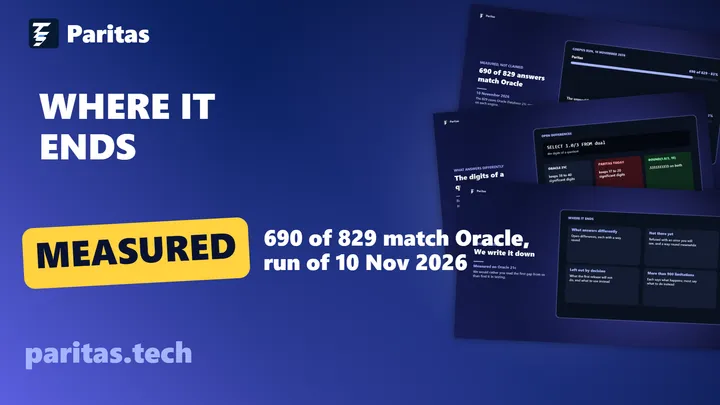
Where Paritas stands
We run the same SQL on Oracle Database 21c, on Paritas and on the unmodified open-source base Paritas is built from, and compare each answer with Oracle's. A case counts only when it gives Oracle's answer.
Answers that match Oracle
Corpus run of 10 November 2026: the 829 cases Oracle Database 21c answers.
Each case is a piece of SQL or PL/SQL run on each engine, and compared with Oracle's value or, for an error case, the class of Oracle's error.
Each measure at its latest run
Paritas alone, against Oracle Database 21c.
The compile count is of the package-level units in nine real schemas that Oracle 21c itself compiles, among them the Alexandria, Logger, utPLSQL and PL/JSON libraries and Oracle's HR and OE samples. About 760 of the 2,994 package call sites are in packages left out of the first release by decision. The errors measure covers the codes handlers catch, SQLCODE, SQLERRM and RAISE_APPLICATION_ERROR.
How the answers compare kind by kind, from NUMBER to format models, is on Why Paritas.
The Oracle that real code is written in
Each item below is tested against Oracle 21c's measured answers. Most arrived because our gauntlet of real schemas ranked them first.
Packages
- Specification and body, with state kept per session
- Package records, constants, cursors and initialisation sections
- Types, subtypes and exceptions declared in a package and used from other code
- Private body items, and recursion that keeps each caller's values
The PL/SQL language
SUBTYPE, and predefined subtypes such asPOSITIVEandNATURALPLS_INTEGER,SIMPLE_INTEGER,SYS_REFCURSORand cursor attributesSELECT INTO,EXECUTE IMMEDIATE,OPEN ... FORa query in a string, and procedure calls withoutCALLFOR ... IN REVERSEin Oracle's order
Exceptions
- User-defined and predefined exceptions, raised and caught by name
PRAGMA EXCEPTION_INITwith Oracle's scope and codesRAISE_APPLICATION_ERROR, andSQLCODEandSQLERRMin handlers
Collections and types
- Nested tables,
VARRAY, andINDEX BYtables keyed byPLS_INTEGERorVARCHAR2 BULK COLLECT,TABLE()in a query, and pipelined functions- Schema-level object types with attributes, and collection types, with constructors
Triggers and SQL
- Oracle's trigger syntax:
:new,:old,INSERTING,UPDATING,DELETING ROWNUMcounted for each query block, in joins, subqueries and the nested pagination idiomLIKEwithESCAPEas Oracle reads it, and theREGEXP_functions in Oracle's own pattern languageMINUSand Oracle's set-operator order; an empty string read as NULLBINARY_FLOATandBINARY_DOUBLE, and numbers written as text as Oracle writes them
Running it
- One mode for the whole server, Oracle's, on either of its two ports
- PostgreSQL's client tools, drivers and extensions, and PL/pgSQL beside your Oracle code
DBMS_OUTPUT,DBMS_LOB,UTL_RAWand part ofDBMS_UTILITY- Logical replication to another Paritas server or to a stock PostgreSQL 18 subscriber, tested in November 2026
- Builds on Linux and on Windows
Open differences, and what to do instead
These run without an error and give a different answer from Oracle's, which is why we list them first. Each was found by measuring on Oracle 21c, and each has a way round that gives the same answer on both.
| What | On Paritas today | What to do |
|---|---|---|
| Division of two integers | 10/4 is 2 and 1/3 is 0, as in PostgreSQL. Oracle gives 2.5. | Write one side as a decimal (10/4.0) or CAST(... AS NUMBER). A NUMBER column or variable divides as Oracle's does. |
| The digits of a quotient | 1.0/3 keeps 17 to 20 significant digits, where Oracle keeps 38 to 40. | ROUND to the digits that matter: ROUND(1.0/3, 10) is .3333333333 on both. |
GREATEST and LEAST with a NULL | GREATEST(5, NULL) is 5. Oracle gives NULL. | CASE WHEN a IS NULL OR b IS NULL THEN NULL ELSE GREATEST(a, b) END |
| DDL inside a transaction | Transactional, as in PostgreSQL: a ROLLBACK after a CREATE TABLE undoes it and the work before it. Oracle commits before and after each DDL statement. | COMMIT before and after the DDL. An implicit commit, as Oracle does it, is on our work list. |
| A package's subprogram with the default rights, called by another role | Runs with the caller's rights. Oracle runs it as the owner. | Qualify names with their schema, and grant the caller what the code reads. |
NEXTVAL named twice in one row | Each reference moves the sequence on. | NEXTVAL once and CURRVAL for the others, which gives the same value on both. |
On a narrow screen, scroll the table sideways.
On our work list
These are refused today, with an error you will see, and each has a way round meanwhile. pgrecon flags many of them in your code before you start.
Packages still to come
DBMS_SQL, UTL_FILE, DBMS_ASSERT, DBMS_RANDOM, DBMS_APPLICATION_INFO and DBMS_CRYPTO are planned for the first release. DBMS_STATS, DBMS_PIPE and DBMS_ALERT are planned too; until then, ANALYZE keeps a table's statistics.
Autonomous transactions
A procedure holding PRAGMA AUTONOMOUS_TRANSACTION is created with a compilation error, and each call fails. They are planned for the first release. We will not ship a shim that fakes them, because a fake would be a trap.
Hierarchical queries
CONNECT BY, START WITH and PRIOR are a syntax error today. Meanwhile, write the query with WITH RECURSIVE, and use generate_series for the row generator.
Global temporary tables
CREATE GLOBAL TEMPORARY TABLE makes PostgreSQL's session temporary table, so the definition lasts only for the session that made it. Meanwhile, create the temporary table in each session before the code that uses it. More on this trap
FORALL and LISTAGG
FORALL is a syntax error: a FOR loop round the statement gives the same rows. LISTAGG is absent: string_agg(x, ',' ORDER BY k) gives Oracle's list.
Object types with methods
Type bodies, member functions, UNDER and REF are refused. Keep the data as a type with attributes, and the methods as package subprograms, until they arrive.
What Paritas will not do at first, and what to use instead
| What | What to use instead |
|---|---|
UTL_HTTP, UTL_TCP, UTL_SMTP, UTL_MAIL | A service beside the database that does the network work. |
The XML packages (DBMS_XMLGEN, DBMS_XMLDOM and others) | The XML functions on text, such as XMLELEMENT and XMLTYPE(), work. |
DBMS_SCHEDULER and DBMS_JOB | pgrecon rewrites the scheduling calls. |
| Optimiser hints | Read as comments. pg_hint_plan can be installed beside Paritas. |
| Database links | A foreign table over postgres_fdw for a remote PostgreSQL or Paritas table. A link to an Oracle database has no equivalent here. |
| Flashback queries and tables | Point-in-time recovery from the WAL archive for a whole cluster, or a history table a trigger fills. |
| Transparent data encryption | Encrypt the volumes the data, the WAL and the backups live on. Encryption at rest inside the database is planned first after the first release. |
| Restoring an Oracle backup or Data Pump file | The schema comes across as Oracle's DDL and the rows by COPY. Paritas restores only an archive its own pg_dump made from a Paritas database. |
More than 900 entries, each saying what happens
Our list of limitations is written from measurements on Oracle 21c. Each entry says what happens, and most say what to do instead. We would rather you read the first gap from us than find it in testing. A customer copy of the list is planned for when Paritas is packaged. Until then, ask us about any construct your code uses.
Procedural language
Corners of PL/SQL: where a COMMIT may stand, what a caught error keeps, the rights a call runs with, cursors that outlive their block.
SQL and data types
Numbers, strings, dates and intervals at their edges, format models, character sets, and functions not there yet.
Collections
The less common forms of nested tables, VARRAY and associative arrays.
Built-in packages
Which DBMS_ and UTL_ packages are present, which members are missing, and which are planned. pgrecon's report lists your call sites by package.
PostgreSQL extensions
Where an extension written for PostgreSQL meets Oracle-mode types and text, with the way round where there is one.
Operations
Dumps, restores, upgrades, VACUUM, long transactions and what happens when a server process stops. More in the traps